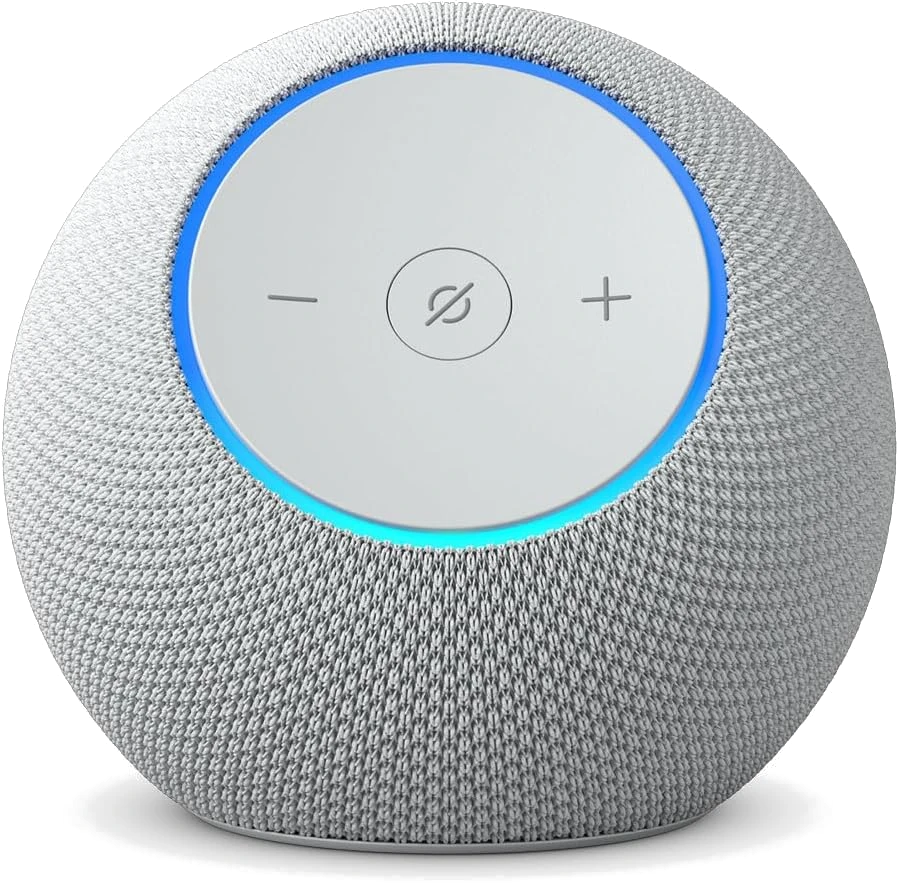
Smart speakers usually sound like a phone stuck in a coffee mug. For years, the industry standard for entry-level smart audio has been incredibly tinny and disappointingly flat. The Echo Dot Max is Amazon's deliberate attempt to finally fix that acoustic problem. Amazon claims this little sphere pushes nearly 3x the bass of the previous 2022 Echo Dot, and looking at the internal hardware, they’ve crammed in a 2.5-inch woofer alongside a dedicated 0.8-inch tweeter to back up that bold claim.
Translation: you are finally getting a real low-end driver to handle the bass, rather than relying on one tiny, overworked speaker trying to do everything from rumbling basslines to high-pitched alarms. For a smart puck that can still comfortably fit in the palm of your hand, packing in a two-way mono audio system is an impressive feat of engineering.
What Is the Echo Dot Max?
It's Amazon's newest top-tier entry in the compact smart speaker lineup—the highly anticipated 2025 release, looking sleek in Glacier White. Think of it as the regular Echo Dot that spent the last year hitting the gym. It retains the exact same small, unassuming footprint you're used to, measuring in at just 4.27 inches square and 3.9 inches tall, making it easy to tuck onto a bookshelf or nightstand. But beneath that familiar fabric mesh, it features two-way mono audio. By splitting the work between a separate tweeter specifically for crisp highs and a custom woofer for resonant lows, the audio separation is radically improved.
Powering all of this is the brand-new AZ3 chip featuring a dedicated AI accelerator. In practical terms, this is a processor with a lot of extra muscle designed specifically for handling Alexa voice commands locally on the device. This means faster response times, fewer trips to the cloud, and a much snappier experience when you're asking it to run routines or control your home.

The audio range runs from 53 Hz up to 16 kHz at volume level 6. That 53 Hz spec is the real headline here. For a speaker of this size, dropping down to 53 Hz means you are getting frequencies low enough to actually feel the thump of a kick drum, rather than just hearing a hollow imitation of one.
Who Should Buy the Echo Dot Max?
You should absolutely buy this if you're still running a 3rd- or 4th-generation Echo Dot and the lackluster sound quality has started to annoy you. The massive 3x jump in bass response is the single biggest, most noticeable reason to upgrade your hardware.
It is also an incredibly smart buy if you are looking to streamline your setup by having one box act as both a speaker and a universal smart home hub. The Echo Dot Max packs Zigbee, Matter, and a Thread border router directly inside. In plain terms: this speaker talks directly to your smart bulbs, smart locks, and window sensors without requiring you to plug a separate, proprietary hub into your router. You get to skip the extra $40 to $60 bridge that usually ends up gathering dust in a utility closet.

Finally, buy it if you already own an eero mesh WiFi system. The Dot Max cleverly doubles as an eero range extender, effortlessly adding up to 1,000 square feet of Wi-Fi coverage to your home. It’s perfect for blasting a signal out to a dead zone in your garage or a back bedroom. However, you should skip this model if you're an audiophile strictly chasing true stereo separation. Because one unit operates in mono, you'd need to purchase two units and link them to get a genuine left-right soundstage.
Echo Dot Max Specs and Key Features
- Nearly 3x the bass: A 2.5-inch woofer and 0.8-inch tweeter push down to 53 Hz, versus the thin sound of the 2022 Dot.
- Built-in smart home hub: Zigbee, Matter, and Thread border router on board, so your gadgets connect without a separate hub.
- eero WiFi extender: On an eero network, it adds up to 1,000 sq. ft. and speeds up to 100 Mbps for 10 or fewer devices on the 5GHz band.
- Omnisense sensors: Temperature, light, and presence detection plus tap gestures, so routines can fire when you walk in or the room hits a set temp.
- Wi-Fi 6E and Bluetooth 5.3: The newest wireless bands, which means less congestion when your house has 40 other gadgets fighting for bandwidth.
The Honest Take on the Echo Dot Max
There are two distinct catches you need to be aware of before buying. First, that brilliant WiFi extender trick only works if you already own a compatible eero router. No eero, no bonus network coverage. Do not buy this expecting to get free mesh WiFi out of thin air if you are using a standard router from your ISP.
Second, Amazon Sidewalk is enabled by default right out of the box. That's the controversial neighborhood networking feature that shares a tiny sliver of your internet bandwidth with nearby, low-power devices. The bandwidth used is incredibly small, it's completely optional, and you can easily shut it off in the Alexa app settings—but you should absolutely know it's running in the background.
And one more reminder: it's mono. It’s one brilliantly engineered speaker pushing out a single audio channel. It is absolutely fantastic for filling a kitchen or a bedroom with rich background music, but it is not a stand-in for a real stereo pair.
Echo Dot Max FAQ
Q: Is the Echo Dot Max worth upgrading from an older Dot? If your old one is the 2022 model, the nearly 3x bass alone makes a noticeable difference, especially on music. You also get the built-in Zigbee/Matter/Thread hub and Wi-Fi 6E, which the old puck didn't have. If you only use Alexa for timers and weather, the upgrade matters a lot less.

Q: Does the Echo Dot Max need an eero router for the WiFi feature? Yes. The 1,000 sq. ft. extender feature only kicks in on a compatible eero network, and you manage it from the eero app. Without eero, it's still a full smart speaker, you just don't get the mesh boost.
Q: Can I pair two for stereo sound? You can. Pair two Echo Dot Max units for richer, fuller audio, or link one to a Fire TV for a makeshift home theater setup. A single unit is mono, so two is the move if you want real left-right separation.
The Verdict on the Echo Dot Max
The Echo Dot Max is definitively the best-sounding small Echo that Amazon has produced to date. By including a real woofer, a deeply integrated smart home hub that supports the latest Matter and Thread protocols, and an incredibly useful eero WiFi bonus for those already in that networking ecosystem, it punches well above its weight class. Buy it to immediately replace an aging, tinny Echo Dot, but pass on it if you are expecting true stereo separation out of a single box, because at the end of the day, mono is mono.