The interesting thing about training data is that it's only useful if you can understand it. Heart rate zones, training load, recovery time, these are powerful concepts buried inside most GPS watches behind menus and numbers that don't connect to a runner's daily reality. The Garmin Forerunner 165 review most runners write after a few months with it isn't about specs. It's about the daily readiness score that told them when to back off, and the suggested workout that turned out to be exactly what their body needed.
What It Is
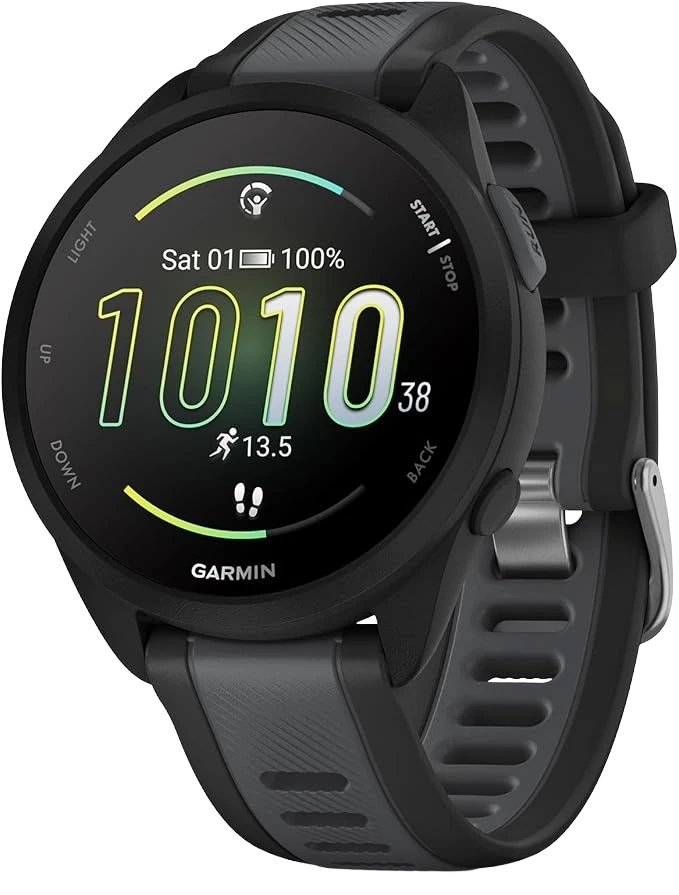
The Garmin Forerunner 165 is a GPS running watch with a vivid 1.2" AMOLED touchscreen, multi-GNSS location tracking, and a feature set that Garmin previously reserved for models costing $100–150 more. It's currently at a record-low $195, down from its regular $249 price, a 20% discount that makes it the most attractive it's been since launch.

Inside the watch: Training Readiness, a daily score that aggregates your sleep quality, HRV, stress levels, and recent training load into a single number that tells you how hard to push today. Daily Suggested Workouts, an adaptive plan that prescribes specific workouts based on your current fitness and recovery. Up to 11 days of battery life in smartwatch mode, 19 hours in GPS mode. The screen is legitimately beautiful, sharp, bright, and readable mid-run without adjusting display settings.
Who It's For
- New runners building a training base who want expert coaching baked into their watch
- Intermediate runners who've outgrown a basic fitness tracker and want GPS accuracy plus genuine training guidance
- Anyone who's wanted a Garmin but couldn't justify the $349+ price of the Forerunner 265 or 965
- Strava users who want detailed, accurate data that syncs automatically after every run
Key Features
- Training Readiness score — aggregates sleep, HRV, stress, and recent load into a daily number; used to be locked behind $350+ Garmin models; tells you concretely whether to push, maintain, or recover today
- Daily Suggested Workouts — adaptive workout plans that respond to your actual fitness level and recovery; the coaching intelligence that makes entry-level runners improve faster
- 1.2" AMOLED touchscreen — vivid and readable in full sun without adjusting brightness; the screen alone distinguishes it from every LCD watch at this price
- 11-day battery (smartwatch) / 19-hour GPS — charge once a week on a typical training schedule, or once every 4–5 days during marathon build phases
- Multi-GNSS GPS (GPS, GLONASS, Galileo), accurate in urban canyons, dense tree cover, and mountainous terrain where single-band watches consistently drop signal
Honest Take
The Forerunner 165 has no music storage. If you want to leave your phone at home and run to a curated playlist, you'll need to stream over Bluetooth from a phone, or look at the Forerunner 265 ($349) which adds offline music. This is the primary feature gap between the two models, and for many runners it's the deciding question.

It also lacks some of the broader biometric tracking available on higher-end Garmins (HRV Status, Training Effect label). For pure running, which is what this watch was built for, neither gap matters until you're training at a fairly advanced level.
FAQ
Q: How does the Garmin Forerunner 165 compare to the Forerunner 265? The 265 ($349) adds offline music storage, a slightly larger 1.3" AMOLED display, HRV Status, and a brighter screen. At $195, the 165 captures the core training features that matter most for 80% of runners at a $154 saving. Unless offline music is a daily need, the 165 is the better value right now, especially at this record-low price.

Q: Is the Garmin Forerunner 165 good for beginners? It's one of the best beginner running watches available. The Daily Suggested Workouts feature is particularly valuable for new runners, it recommends specific workouts based on your current fitness and how recovered your body is, removing the guesswork from building a training program. Experienced runners training for half marathons and below will find it fully capable without ever hitting its limits.
Q: Does the Garmin Forerunner 165 sync with Strava? Yes, Garmin Connect syncs with Strava automatically after every run. GPS data, pace zones, heart rate, training load, and splits all transfer over. You can also configure Strava Live Segments directly on the watch for real-time performance feedback on your favorite routes.
Verdict
At $195, the Garmin Forerunner 165 is the best running watch at its price point by a meaningful margin. Training Readiness and adaptive workouts at this price used to be impossible, and right now, they're on sale.